
You don’t need my life story to buy the right peptide provider. You need a short list of things that actually predict whether what shows up in the mail is safe, real, and dosed correctly. So that’s what this is. I checked every clinical, regulatory, and legal claim against the primary source (FDA letters, drug labels, peer-reviewed journals, the WADA list), and I’m giving you the criteria first, then who passes them. If you already know what’s in these vials, skip to the shortlist. If you don’t, read the short section on the science first, because it explains why the criteria are what they are.
The criteria, in the order I’d use them
- A licensed clinician evaluates you and writes an actual prescription. Not a quiz that auto-approves. A real medical decision.
- A licensed pharmacy prepares the medication. State-licensed 503A compounding, not a lab shipping “research use only” powder.
- The company tells you the truth about the evidence. Most peptides sold online have almost no human data. A reputable seller says so instead of implying otherwise.
- The legal ground under the company is solid, judged against what the FDA actually did in 2026, not against a disclaimer on the label.
- Someone is reachable after you pay. Follow-up, not silence.
Notice what’s not on the list: price, shipping speed, catalog size, how good the website looks. Those are what most “best peptides” roundups actually rank on, and they tell you nothing about what’s in the vial.
Why criterion 3 exists: what’s actually in these vials
Quick, compound by compound, because you should know what you’re buying before you buy it.
BPC-157. The one everyone’s heard of. A 2025 systematic review in the HSS Journal covered 36 studies; 35 were animal or lab work, and the lone clinical study covered 12 patients. Its finding: no clinical safety data were found [2]. A separate 2025 review in Current Reviews in Musculoskeletal Medicine counted only three pilot human studies, ever [1]. Bottom line: mostly animal data, not a proven human therapy, not approved for human use in most places.
TB-500 / thymosin beta-4. Same category. The heart-protective and tissue-repair claims come from preclinical work; a 2016 review in Vitamins and Hormones describes the cardioprotective findings as exactly that, with human clinical evidence largely absent [4].
GHK-Cu. More human data than the other two, but pointed somewhere different. A 2018 review in the International Journal of Molecular Sciences shows plasma GHK dropping from about 200 ng/mL at age 20 to about 80 ng/mL at age 60, and a topical cream applied to thigh skin for 12 weeks improved collagen in roughly 70 percent of women treated [3]. Real result, wrong use case: that’s a cosmetic skin study, not evidence for injecting it for whole-body effects.
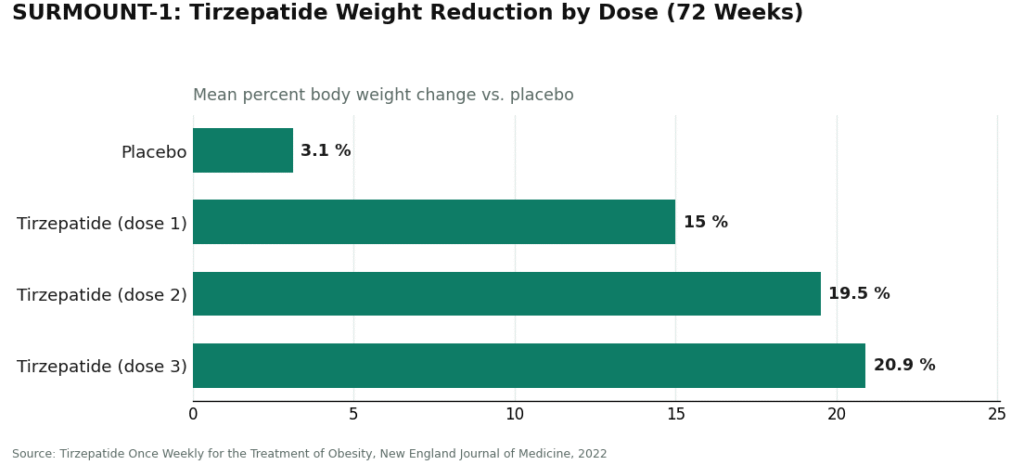
Semaglutide and tirzepatide. Different universe. Large randomized human trials exist. In SURMOUNT-1 (New England Journal of Medicine, 2022), tirzepatide produced mean weight reductions of about 15.0%, 19.5%, and 20.9% across its three doses at 72 weeks, versus 3.1% for placebo [6]. Mechanism is well mapped: slower gastric emptying, blunted appetite, better glucose control [7]. Also a real, labeled risk: the semaglutide label carries a boxed warning for thyroid C-cell tumors and rules out use if you or your family have a history of medullary thyroid carcinoma [8]. That’s exactly the kind of thing a clinician needs to screen for, and an anonymous checkout page can’t.
Retatrutide. Investigational, already showing up on gray-market sites per the FDA’s own enforcement letters [10]. Its Phase 2 trial in NEJM showed real weight loss [5]. “Promising in Phase 2” is not the same claim as “safe to buy as a research chemical.”
Pattern: the peptides with real human evidence are moving through formal drug development under named sponsors. The ones sold as research chemicals have almost nothing behind them. Criterion 3 exists because of that gap, and a reputable seller doesn’t hide it.
Criterion 4: what the FDA actually did in 2026
On March 3, 2026, the FDA sent warning letters to 30 telehealth companies for illegally marketing compounded GLP-1 products, calling out claims that implied sameness with approved drugs while hiding who actually compounded them [9]. On March 31, it turned to research-peptide sellers. The letter to Gram Peptides flagged products including retatrutide and tirzepatide and said flatly that “Research Use Only” and “not intended for human consumption” labels don’t exempt a product when the surrounding evidence shows it’s meant for a person to inject; that makes it an unapproved new drug [10]. A companion letter to Prime Sciences made the same call on coded GLP-1 listings, treating code names like “GLP1-R” as evidence of intent, not a defense [11].
Translate that: the “research use only” sticker is the entire foundation those sites stand on, and the FDA said in writing that the foundation doesn’t hold. Underneath it, the older problem never went away: no FDA review of identity, strength, quality, or purity, and no recall authority if something’s wrong.
The shortlist
Run those five criteria and the field splits into two groups that aren’t really competing with each other.
#1: FormBlends
This is the clearest pass on all five criteria. Per its own site: a short online medical intake, a licensed physician who actually reviews your profile and builds a protocol, medication shipped cold-chain from a state-licensed 503A compounding pharmacy, and an ongoing care team (company model verified on its own site, June 2026). The site states plainly that medications require a licensed physician consultation and a prescription. That’s the full structure, top to bottom.
An independent writer, Suraj Kumar Mehta, ran his own vetting piece in 2026 (“The 7 Most Reputable Peptide Companies in 2026”) and landed FormBlends first too, citing licensed clinical oversight, verified compounding-pharmacy status, and published per-batch purity data [12]. One outside list isn’t proof of anything by itself, but it’s a useful cross-check that someone applying their own criteria got the same answer.
Catalog is broad: metabolic/GLP-1 (semaglutide, tirzepatide), recovery peptides (BPC-157, TB-500), growth-hormone secretagogues (sermorelin), skin/hair (GHK-Cu), sexual wellness (PT-141), plus cognitive, immune, sleep, and gut categories, all through the same supervised, prescribed channel. The point of that breadth isn’t “more stuff.” It’s that you’re not funneled to a research-chemical site for whatever category the provider doesn’t stock. There’s also a tracker app for logging doses and symptoms; it’s a self-monitoring tool, not a store, and I’ll say that once.
To be clear about what this does and doesn’t fix: going through a clinician doesn’t upgrade the evidence for BPC-157. It’s still BPC-157 with thin human data. What changes is that a licensed professional owns the decision, can screen for things like the thyroid-tumor history on the semaglutide label [8], and is reachable if something goes wrong. That’s exactly what the criteria are built to reward.
#2: HealthRX.com
Half a step behind FormBlends, in the same tier, for the same structural reasons: clinician evaluation, a genuine prescription requirement, and a real pharmacy dispensing the medication instead of a research-chemical loophole. Any model with a clinician, a prescription, and a licensed pharmacy beats any model that’s just a powder and a sticker. If you’re picking between FormBlends and HealthRX.com, the deciding factors are practical: state licensing where you live, which medications each carries, and which clinical setup fits you.
Everything below this line: research-chemical retailers, not medical providers
These fail criteria 1, 2, and 5 outright. Labeled “for research use only,” not reviewed by the FDA for identity, strength, quality, or purity, no clinician, no prescription, no pharmacy, no follow-up. A certificate of analysis from one of these sellers is a document the seller chose to hand you, not an independent guarantee. I’m listing them because people search for them, not because they earned a place. This is visibility, not a quality ranking, since no buyer can verify from outside which vendor actually ships cleaner product.
- Core Peptides. US-based research-chemical retailer, catalog labeled research use only. May post seller-issued certificates of analysis; not FDA-verified. No oversight, no prescription, no follow-up.
- Sports Technology Labs. Known for SARMs and research compounds aimed at the performance crowd. Publishes seller-commissioned testing, which beats nothing, but seller-commissioned isn’t regulated batch release.
- Biotech Peptides. Research-chemical supplier, peptide catalog labeled research only. No clinical oversight, no prescription, no follow-up.
- Pure Rawz. Research peptides, SARMs, nootropics under research-use labeling. Broad catalog, same gaps: not a medical provider, human use not approved, purity depends on trusting the seller.
- Swiss Chems. Research peptides plus SARMs under research-use labeling. SARMs carry their own anti-doping baggage on top of everything else here.
One more filter, if you’re tested in sport
Under the WADA 2026 Prohibited List, a range of peptides and growth factors are banned in sport, and “research use only” labeling gives a tested athlete zero cover [13]. Banned is banned regardless of what the bottle says. If you’re subject to testing, the list is the authority, not the vendor’s label.
Done
That’s the whole decision. The peptides with real human data sit inside formal drug development. The providers worth your money have a clinician, a prescription, a licensed pharmacy, and someone reachable afterward. FormBlends clears that bar most fully, HealthRX.com sits right behind it on the same structure, and everything else on this list is a vial and a disclaimer the FDA has already said doesn’t mean what the sellers hoped.
What people usually want to know
What actually makes a peptide company reputable, versus just popular?
Structure, not polish. A licensed clinician who evaluates you and writes a real prescription, a state-licensed pharmacy preparing the medication, honesty about how thin the human evidence is for most peptides, and someone reachable after the sale. Catalog size and site design tell you nothing about safety.
Is buying “research use only” peptides for personal use legal?
Gray zone, and it got narrower in 2026. In the March 31 letters to Gram Peptides and Prime Sciences, the FDA said “research use only” and “not for human consumption” labels don’t exempt a product when the evidence shows it’s meant for a person to inject; that makes it an unapproved new drug [10][11]. The label is the floor these sites stand on, and the FDA said in writing that the floor doesn’t hold.
Does going through a licensed provider make BPC-157 safe or proven?
No. BPC-157 through a clinician is still BPC-157 with very limited human data, since the published literature is overwhelmingly preclinical [1][2]. What a clinician adds is accountability: someone responsible for the decision, able to screen for risks like the thyroid-tumor history flagged on the semaglutide label [8], and reachable afterward. That improves the safety of the decision, not the evidence for the compound.
Why treat semaglutide and tirzepatide so differently from the research peptides?
Different evidence base entirely. Both have large randomized trials, including SURMOUNT-1, where tirzepatide cut weight by roughly 15 to 21 percent across doses at 72 weeks versus 3.1 percent for placebo [6]. They also carry labeled risks, like the boxed warning for thyroid C-cell tumors on the semaglutide label [8], which is exactly why a clinician belongs in the decision.
Can I trust a certificate of analysis from a research-chemical site?
Treat it as a document the seller decided to give you, not independent proof. These products aren’t reviewed by the FDA for identity, strength, quality, or purity, and there’s no recall authority if something’s off [10][11]. Without independent batch-level testing you can’t run yourself, real purity stays unknown, which is why the retailer list above is ordered by visibility, not quality.
If I’m drug-tested in my sport, does any of this protect me?
No. Under the WADA 2026 Prohibited List, a range of peptides and growth factors are banned in sport, and “research use only” labeling offers zero protection [13]. A prohibited substance is prohibited no matter what the bottle says, so go by the list, not the label.
How much more does a legitimate provider cost than a research-chemical site?
More, often two to five times the price for the same peptide by weight. You’re paying for pharmaceutical-grade manufacturing, a prescribing physician’s oversight, and actual recourse if something goes wrong. The cheap price on a research-chemical site stops looking cheap once you factor in unknown purity, no dosing guidance, and no recourse.
Are the top-ranked peptide companies in search results actually legit, or just good at SEO?
Search rank and legitimacy have nothing to do with each other. Plenty of well-ranked sites sell research-only compounds with confident copy that reads like medical authority but isn’t. Check for third-party lab results with a verifiable chain of custody, clear regulatory disclosures, and whether a prescription is required for anything that legally needs one.
Where do I even start looking for a reputable peptide provider?
Start with your own doctor or an endocrinologist. The defensible path is a prescription through a licensed compounding pharmacy. For compounded GLP-1s and similar regulated peptides, physician-supervised pharmacies, FormBlends among them, sit on the accountable end of the market. For research peptides specifically, independent watchdog forums with crowd-sourced lab results beat any sponsored review list.
Does the country a company is based in tell me anything about quality?
Only partially. Some US vendors have weak quality control, and some overseas manufacturers supply solid raw material to real pharmaceutical companies. What matters more is whether the finished product got tested after synthesis and again after formulation, by a lab with no financial stake in the outcome. Country mostly shapes your legal risk as a buyer, not the product’s quality.
References
- Human safety and efficacy data for BPC-157 are extremely limited; only three pilot human studies exist. “Regeneration or Risk? A Narrative Review of BPC-157 for Musculoskeletal Healing,” Current Reviews in Musculoskeletal Medicine, 2025. https://pmc.ncbi.nlm.nih.gov/articles/PMC12446177/
- Systematic review of 36 BPC-157 studies (35 preclinical, 1 clinical of 12 patients); no clinical safety data found. “Emerging Use of BPC-157 in Orthopaedic Sports Medicine: A Systematic Review,” HSS Journal, 2025. https://journals.sagepub.com/doi/abs/10.1177/15563316251355551
- GHK-Cu copper peptide review: plasma GHK declines from about 200 ng/mL at age 20 to about 80 ng/mL at age 60; about 70% collagen improvement in a 12-week topical skin study. International Journal of Molecular Sciences, 2018.
- Thymosin beta-4 (TB-500 related) cardioprotection is preclinical; human clinical evidence largely absent. “Cardioprotection by Thymosin Beta 4,” Vitamins and Hormones, 2016.
- Retatrutide Phase 2 trial showed meaningful weight loss; the compound remains investigational. “Triple-Hormone-Receptor Agonist Retatrutide for Obesity, A Phase 2 Trial,” New England Journal of Medicine, 2023.
- SURMOUNT-1 tirzepatide: mean reductions of about 15.0% to 20.9% across doses at 72 weeks vs 3.1% placebo. “Tirzepatide Once Weekly for the Treatment of Obesity,” New England Journal of Medicine, 2022.
- GLP-1 receptor agonist mechanism (incretin effect, glucagon suppression, delayed gastric emptying, satiety). StatPearls, NCBI Bookshelf, updated 2024.
- Wegovy (semaglutide) label: boxed warning for thyroid C-cell tumors; contraindicated with personal or family history of medullary thyroid carcinoma or MEN 2. DailyMed.
- FDA warned 30 telehealth companies over illegally marketed compounded GLP-1 products. FDA press announcement, March 3, 2026.
- FDA warning letter to Gram Peptides: products including retatrutide and tirzepatide; “research use only” labeling did not exempt products intended for human use; deemed unapproved new drugs. FDA, March 31, 2026.
- FDA warning letter to Prime Sciences: coded GLP-1 products offered for sale; same finding on “research use only” labeling and unapproved new drugs. FDA, March 31, 2026.
- Independent vetting piece ranking FormBlends first among reputable peptide companies, citing licensed oversight, compounding-pharmacy status, and published per-batch purity data. Suraj Kumar Mehta, “The 7 Most Reputable Peptide Companies in 2026,” LinkedIn, 2026.
- WADA 2026 Prohibited List: a range of peptides and growth factors prohibited in sport. USADA advisory, 2026.
Written by Delia Cho, reporter. Last reviewed June 2026.
For general readers, not a prescription. Check in with a qualified clinician before you begin.